Reviewed by the REYDS detection team, Pretoria · Updated
What is water leak detection?
Water leak detection is the process of locating where water is escaping from a plumbing system, pool or building envelope before anything is opened up. It is diagnosis, not repair: the survey answers “where exactly is the water going?” so the plumber can cut once, in the right place.
On a typical South African property the work takes one to three hours. A technician isolates the system into zones, listens to the pipework, scans walls and floors with a thermal camera, and confirms the escape point with pressure, gas or dye testing. You leave with a marked leak position, photographs and a written report that a plumber or insurer can work from.
Detection matters because water damage is cumulative. A leak losing the equivalent of a bathtub a day quietly lifts tiles, feeds rising damp and inflates a municipal bill, while a burst geyser can flood a ceiling in minutes. Finding the point early is almost always cheaper than replacing the finishes it destroys.
What are the first signs of a hidden water leak?
Hidden leaks rarely announce themselves. They show up as small inconsistencies in the bill, the meter, the floor temperature or the paintwork. These are the six signals we are called out for most often across Pretoria, Johannesburg and Cape Town.
Your bill climbs while your habits stay the same
A jump of more than about 20% on a municipal bill with no new pool filling, irrigation or extra people in the house usually means water is leaving the system somewhere you cannot see. Compare two consecutive bills before you accept a leak as the cause.
The meter keeps turning with every tap closed
Close all taps, switch off the irrigation controller and confirm the geyser is not refilling, then watch the water meter for five minutes. Any movement on the dial proves a loss on the pressurised supply side, which is the clearest single test a homeowner can do.
A warm or hot patch on a tiled floor
A hot spot on a slab usually points to a leaking hot-water line beneath the floor. It is the most expensive leak to chase by guesswork, because the wrong break-out costs more than the diagnostic survey.
Damp that returns after painting
Rising damp, a burst pipe in a wall and a failed waterproofing membrane all look alike. Moisture mapping tells them apart before anyone spends money on sealant that cannot work.
A pool that needs topping up every day
Evaporation in Gauteng summer is roughly 5 mm a day. A drop of 25 mm or more in 24 hours, or a bucket test that shows the pool falling faster than the reference bucket, indicates a structural or plumbing leak.
The sound of running water at night
With the house quiet and no appliances running, a hiss near a wall, ceiling or geyser compartment is often the first audible sign of a pressurised leak. Acoustic instruments can hear it long before it reaches a surface.
Each of these symptoms has its own diagnostic page: a meter that keeps running, damp walls, a hot floor patch or a pool losing water.
How does non-invasive leak detection work?
Non-invasive detection means the property is tested from the surface. Drilling, chipping and excavation are the last resort, used only to reach a point that has already been confirmed. The work follows the same four steps on almost every site.
Step 01
Isolate
We split the property into test zones — municipal supply, internal reticulation, geyser circuit, irrigation and pool — and prove which zone loses water. This step alone prevents most unnecessary excavation.
Step 02
Listen
Acoustic microphones and ground probes pick up the frequency signature of water escaping under pressure. Listening is done at night where possible, because traffic and pumps mask the sound during the day.
Step 03
Scan
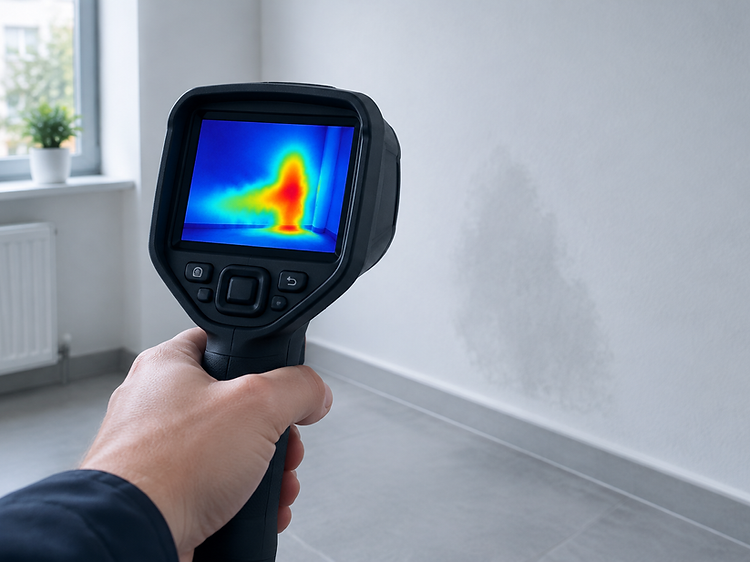
A thermal camera maps temperature differences across walls, floors and ceilings to expose moisture and hot-water lines without opening anything.
Step 04
Confirm
The suspected point is verified with pressure testing, tracer gas or dye testing, then marked on site and photographed. Nothing is cut before the confirmation step agrees with the listening and thermal results.
The techniques are combined rather than used in isolation: Acoustic listening (microphones and ground probes hear escaping water under pressure); Thermal imaging (a camera shows moisture and hot-water lines through a surface); Tracer gas (a harmless gas is traced back to the break point); Pressure testing (zones are isolated and tested to prove which line is losing water); Moisture mapping (gridded readings separate plumbing leaks from rising damp).
What does leak detection cost in South Africa?
Fees depend on how many zones must be isolated and how many methods the diagnosis needs. These are the ranges REYDS quotes for residential work; the fee is confirmed before attendance and is not a repair quote.
| Work | Typical fee | Includes |
|---|---|---|
| Hidden water leak detection (residential) | R850 – R2 500 | Acoustic sweep, thermal scan, pressure isolation, written report |
| Geyser & hot-water line detection | R850 – R2 200 | Geyser compartment, overflow and hot-line tracing |
| Slab leak detection | R1 500 – R5 000 | Zone isolation, correlation, thermal confirmation, marked point |
| Pool leak detection | R500 – R3 500 | Bucket test, pressure test of lines, dye test at fittings |
| Irrigation leak detection | R850 – R2 800 | Zone mapping, valve and solenoid testing, line location |
| Rising damp & moisture mapping | R1 200 – R3 500 | Gridded moisture readings, plumbing exclusion, written diagnosis |
Commercial and multi-unit properties are quoted per site after a system review — see commercial leak surveys. Full ranges, inclusions and after-hours terms are on the pricing page.
Included
- Site assessment and system walk-through
- Non-invasive detection with calibrated equipment
- Marking of the confirmed leak point on site
- Photographs and thermal images
- Written report suitable for your insurer
- No-find, no-fee guarantee
Not included
- Repair, excavation and reinstatement work
- Plumbing materials and fittings
- Damp treatment or waterproofing application
- After-hours call-out surcharge (confirmed before attendance)
Can a leak be found without breaking walls or floors?
In most cases, yes. Water under pressure makes a sound, changes the temperature of the material around it and moves the flow rate of the line it is escaping from — all three can be measured from the surface. A listening sweep over a tiled floor, followed by a thermal scan of the same area and a pressure test of the isolated zone, narrows a leak from an entire house to a patch the size of a dinner plate.
The exceptions are leaks with no pressure behind them, such as a slow drain or a waterproofing failure, and leaks under very thick screed or in inaccessible service voids. Those are confirmed with tracer gas, moisture mapping or a drain camera, and the report states plainly what could and could not be confirmed.
What do you get at the end of the survey?
Every survey closes with a written detection report: the confirmed leak position marked on a site plan or photograph, the methods used and their readings, thermal images, and a statement of what was excluded. That document is what your plumber prices from and what your insurer asks for before authorising a slab, geyser or damp claim — see insurance leak reports.
If the source cannot be found, the survey is not charged — the no-find, no-fee guarantee applies to detection work booked directly with REYDS. We cover Pretoria East, Johannesburg North and Cape Town, with 24/7 dispatch on 069 268 0988.